

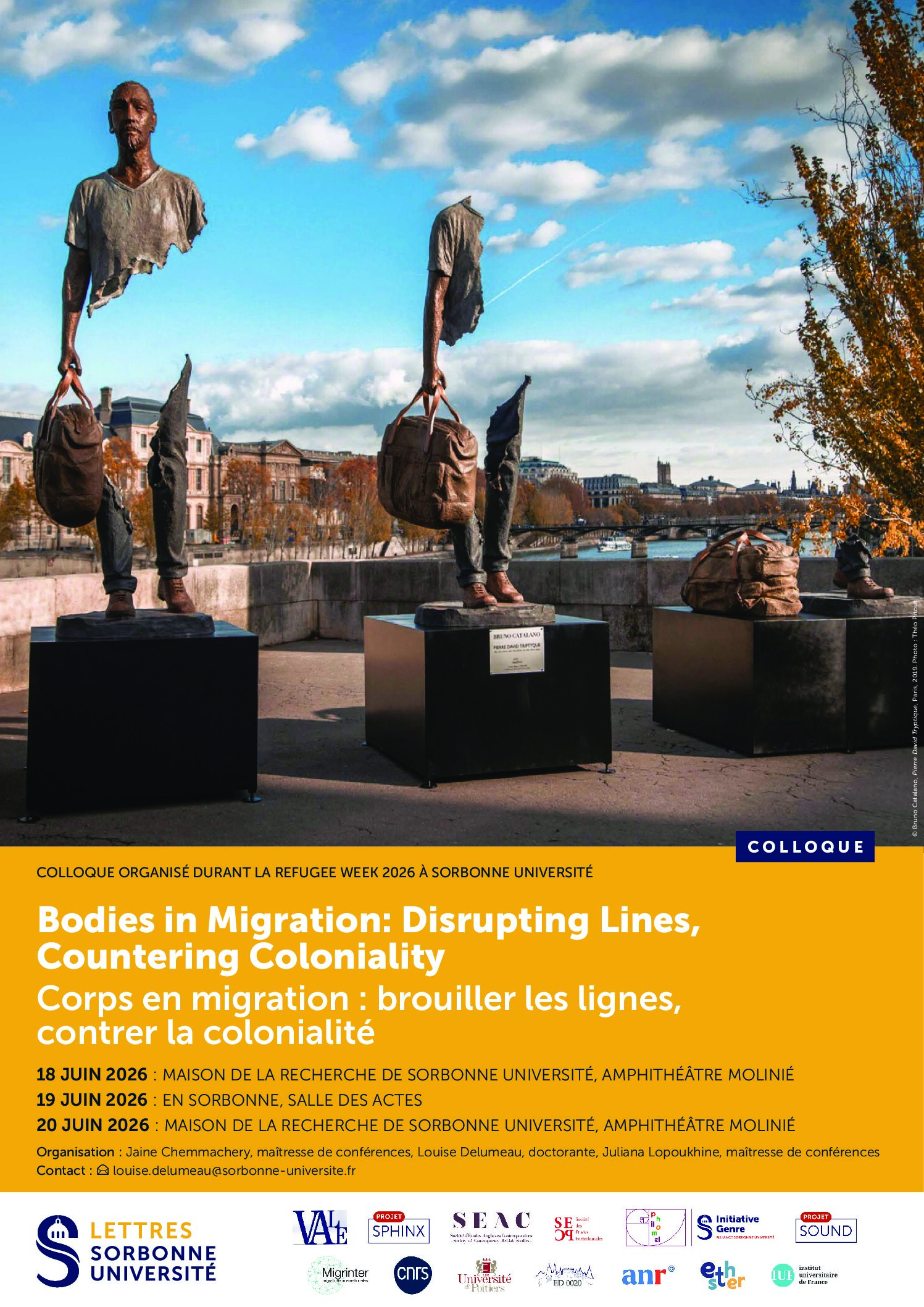
Colloque Bodies in Migration: Disrupting Lines, Countering Coloniality
Corps en migration: brouiller les lignes, contrer la colonialité
18, 19 et 20 juin 2026, Sorbonne Université
Organisatrices / organisers:
Jaine Chemmachery (VALE)
Louise Delumeau (VALE)
Juliana Lopoukhine (VALE / MIGRINTER)
Ce colloque bénéficie des soutiens institutionnels suivants :
CNRS, Direction des affaires culturelles de Sorbonne Université, École Doctorale IV de Sorbonne Université (ED n° 0020), IUF ESTHER, FIR de la Faculté des Lettres de Sorbonne Université, ANR LASNIF, Migrinter (UMR n° 7301), Réseau PHILOMEL, Transculturalismes (VALE UR n° 4085), Société d’Études Anglaises Contemporaines (SEAC), Société d’Etudes Postcoloniales (SEPC), Projet SOUND (France 2030, ANR 22 EXES 0004, Sorbonne Université), Projet SPHINX (France 2030, ANR 24 RSHS 0006, Sorbonne Université), Université de Poitiers.
Keynote speaker: Prof. David Herd (University of St Andrews, co-organiser of the Refugee Tales project)
*
Jeudi 18 juin 2026 / Thursday 18 June 2026
Maison de la recherche de Sorbonne Université, 28 rue Serpente, Paris VIe
Amphithéâtre Molinié
9h Accueil
9h15 Ouverture du colloque: Charlotte Ribeyrol, directrice de VALE / head of VALE
9h30-11h Panel 1: Bodies on the Border / Corps aux frontières (chair: Jaine Chemmachery)
Fiona McCann (Sorbonne Université): Border(line) Body Politics in Paul Lynch’s Fiction
Kerry-Jane Wallart (Université d’Orléans): Crossing the US/Mexico Border – Diasporic Circulations as Formal Experimentation in Cherrie Moraga’s The Hungry Woman, Valeria Luiselli’s Lost Children Archive, and Teju Cole’s Black Paper
Béatrice Blanchet (UCLy): Migrants’ Corporeality and Liminality in (Post-) Colonial Borderscapes: Between Confinement and Displacement
11h-11h30 Pause café / Coffee break
11h30-13h Panel 2: Archives of the Migrant Bodies / Archives des corps en migration (chair: Fiona McCann)
Judith Misrahi-Barak (Université de Montpellier Paul-Valéry): Bodies in Detention, Lives on Hold: A Forensic Reading of Brother, I’m Dying by Edwidge Danticat
Nandini Dhar (Adamas University, Kolkata): Speculative Histories, Confrontational Corporeal Aesthetics and Contemporary Literary Archives of Indenture: Debarati Mukhopadhyay’s Narach and the Quest for an Indian Kalapani Narrative
Lama Boustani / Dominique Claire-Marie (Université de Montréal): Documenter, médiatiser et témoigner des corps migrants dans la ville; retour sur l’exposition transdisciplinaire « Tisser la ville »
13h-14h Déjeuner buffet / Lunch
14h-15h On the Realities of the Hostile Environment: Pious Keku in Conversation with David Herd (Chair: Alexis Tadié)
https://lettres.sorbonne-universite.fr/evenements/les-realites-de-lenvironnement-hostile
15h-16h30 Panel 3: Queer and Gendered Mobilities / Mobilités queer et genrées (chair: Kerry-Jane Wallart)
Naïma Benallal (Sorbonne Université): Vulnerable Bodies and Precarious Lives: Migrant Women Navigating the UK’s Hostile Environment
Neela Cathelain (Sorbonne Université): Haptics and Acrobatics: Queer Ethics of Sensation in John Keen’s Counternarratives (2015)
Elizabeth Hessek (Université de Montréal): Through the Prism of the Border: Refracting Timelines of Mobile Queer Bodies
16h30-17h Pause café / Coffee break
17h-18h30 Keynote address / Conférence plénière (Chair: Vanessa Guignery)
David Herd (University of St Andrews, co-organiser of the Refugee Tales project): Literature and the Voice of Human Rights
https://lettres.sorbonne-universite.fr/evenements/literature-and-voice-human-rights-0
18h30 Cocktail / Drinks reception
20h15 Projection du film Même si tu vas sur la lune de Laurent Rodriguez (2024)
Film screening: Même si tu vas sur la lune by Laurent Rodriguez (2024)
Cinéma Le Champo, 51 rue des Écoles, Paris Ve
Avec Sara Kontar, Ghaith Alali, Khairy Eibesh, Hasan Zahra, Emmanuel Charrier
Sara, Hasan, Ghaith et Khairy ont une vingtaine d’années et sont étudiants à Paris. Arrivés de Syrie, il y a six ans, ils ont le statut de réfugiés. Dans la maison de campagne de leur ami et professeur à l’Université Paris 1, Emmanuel, ils se souviennent de leur vie d’avant, du voyage et des débuts de leur nouvelle vie en France. Sont-ils toujours ceux qu’ils étaient en Syrie ou se sont-ils réinventés avec l’exil ?
Sara, Hasan, Ghaith, and Khairy are in their twenties and are students in Paris. They arrived from Syria six years ago and have refugee status. In the country house of their friend and professor at Paris 1 University, Emmanuel, they recall their lives before exile, their journey, and the beginnings of their new life in France. Are they still who they were in Syria, or have they reinvented themselves through exile
La projection sera suivie d’un débat avec Emmanuel Charrier (Paris I Panthéon-Sorbonne), de Clémentine Vignal, directrice du DU PASSERELLE / RESPE (Faculté des Sciences de Sorbonne Université) et des acteurs et actrices du film.
The screening will be followed by a discussion with Emmanuel Charrier (Paris I Panthéon-Sorbonne), Clémentine Vignal, director of the PASSERELLE / RESPE degree (Sorbonne University Faculty of Science), and the film’s cast.
Modération: Jaine Chemmachery et Juliana Lopoukhine
La projection est soutenue par l’Alliance Sorbonne Université dans le cadre du projet « SOUND – pour un nouvel engagement » – aide de l’Etat gérée par l’ANR au titre de France 2030 et par l’Union européenne NextGenerationEU (ANR – 22 – EXES – 0004)
https://lettres.sorbonne-universite.fr/evenements/meme-si-tu-vas-sur-la-lune
***
Vendredi 19 juin 2026 / Friday 19 June 2026
Sorbonne Université, Salle des Actes, entrée par le 17, rue de la Sorbonne, Paris Ve
9h30-11h Panel 4: Visual Narratives of Mobility and Passage / Récits visuels de la mobilité et du passage (chair: Pauline Amy de la Bretèque)
Patricia Mothes (Institut Catholique de Toulouse, Ceres, EFTS): Photographier le passage de la Manche en 2025
Emmanuelle Kalfon / Nadeera Rajapakse (Université Paris 1 Panthéon-Sorbonne): ‘The Tyranny of the passport’: Bodies on the Move and Identities in Transit within a Bordered World in The Terminal, Le Concert and Machan
Johanna Exenberger (Université Paris Cité): Integrating Photography and Mental Mapping in Participatory Research with Beneficiaries of International Protection
11h-11h30 Pause café, Bibliothèque de l’UFR d’Études anglophones, escalier G, 3ème étage / Coffee break at the Department of English Studies Library, staircase G, 3rd Floor
11h30-13h Panel 5: Migrant strategies of/as resistance / Stratégies migratoires de/comme résistance (chair: Louise Delumeau)
Salma Bahar (Ibn Tofail University): The Poetics of Silence: Embodied Trauma, Memory, and Decolonial Expression in Layla AlAmmar’s Silence is a Sense (2021)
Valentine Lerouge (Sorbonne Université): Under Eastern Eyes: Reversing the Gaze in Anita Rau Badami’s Can You Hear the Nightbird Call?
Martina Balassone (Sorbonne Université): Passing As, Passing Through: Strategic Performances of Identity in Rabih Alameddine’s The Wrong End of the Telescope (2021)
13h-14h30 Déjeuner / Lunch, restaurant Les Patios, Place de la Sorbonne Paris Ve
14h30-15h Freya Powell (artist/Parsons, The New School) in conversation with Jaine Chemmachery about her art installation A Maritime Haunting (location of exhibition TBA)
15h-16h30 Panel 6: “Strangers”, children, and non-humans: Other-ed migrant bodies / “Étrangers”, enfants et corps non-humains: Assignation à l’altérité des corps en migration (chair: Judith Misrahi-Barak)
Pauline Amy de la Bretèque (Université de Nîmes): Liquid migrations: Incorporating/ed Waterscapes in Michelle Cliff’s Free Enterprise (1993)
Joshua Physick (Sorbonne Université / Université d’Orléans): A Re-story-ation of Fractured Boundaries: Decolonial Ecologies in Amitav Ghosh’s Gun Island
Laura Zander (Osnabrück University): The Figure of the Child: Vulnerability, Mediation, and the Biopolitics of the Migrant Body
16h30-17h Pause café, Bibliothèque de l’UFR d’Études anglophones, escalier G, 3ème étage / Coffee break at the Department of English Studies Library, staircase G, 3rd Floor
17h-18h30 Table ronde: Surveillance et résistance des corps en migration : approches croisées / Surveillance and Resistance of Migrant Bodies: Cross-Disciplinary Perspectives (Modération : Juliana Lopoukhine)
David Coelho, conservateur du patrimoine, responsable du fonds Histoire au Musée National de l’Histoire de l’Immigration, Palais de la Porte Dorée
David Coelho, heritage curator at the National Migration Museum in Paris
Catherine Gousseff, historienne, directrice de recherche au CNRS, spécialiste des migrations forcées au sein et en provenance de l’espace soviétique et est-européen au XXe siècle, juge assesseure du Haut Commissariat des Nations Unies pour les réfugiés (HCR) à la Cour Nationale du Droit d’Asile de 2000 à 2005 et de 2012 à 2015
Catherine Gousseff, historian and director of research at the CNRS, specialising in forced migration within and from the Soviet and Eastern European regions in the twentieth century. She also served as an associate judge for the UNHCR at the National Court of Asylum from 2000 to 2005 and again from 2012 to 2015
Touhfat Mouhtare, écrivaine, autrice notamment du roman Choses qui arrivent paru en 2025
Touhfat Mouhtare, writer, author of the novel Choses qui arrivent published in 2025. An English translation of the excerpt by Roopa Chauhan to be read by the author will be provided during the session.
20h Diner de colloque / Conference dinner
Restaurant La Ferrandaise, 8, rue de Vaugirard, Paris Vème
***
Samedi 20 juin 2026 / Saturday 20 June 2026
Maison de la recherche de Sorbonne Université, 28 rue Serpente, Paris VIe
Amphithéâtre Molinié
10h-11h30 Panel 7: (Im)mobilised bodies / Corps (im)mobilisés (chair: Kevin Potter)
Özge Biner (Collège de France): (Im)Mobilized Bodies and Minds in Conflict-affected Borderlands: Encounters and Performances with Actors of War at the Turkish-Syrian Border
Chamindi Perrera (Université de Montpellier Paul-Valéry): Between Mobility and Immobility: Negotiating Embodied Agency in Post-War Migration in Anuk Arudpragasam’s A Passage North
Kateri Smith (independent artist): Ignore the Bodies in the Bins: Indigenous Remains in Collections and the Resistance to Repatriation
11h30-12h Pause café / Coffee break
12h-13h30 Panel 8: Bodies under pressure: biopower and the biopoet(h)ics of migration / Corps sous pression : biopouvoir et biopoét(h)ique(s) de la migration (chair Juliana Lopoukhine)
Kevin Potter (Universität Wien): Striking Kinopoetics: Proletarian Counter-Pressure in Helena Maria Viramontes’s Under the Feet of Jesus
Alice Lacoue-Labarthe (Université de Picardie-Jules Verne): Disrupting the Lines of Nation and Gender: The Exilic Body in Abbas Khider’s Ohrfeige
Jessica Small (Université Grenoble-Alpes): The Biopoetics of Sickness, Medicine and Care in Behrouz Boochani’s Representations of Asylum-Seeker Detention
13h30 Déjeuner buffet / Lunch
En clôture du colloque à partir de 14h : visite de l’installation de l’artiste plasticienne Freya Powell A Maritime Haunting / From 2 p.m. : Visual artist Freya Powell’s installation A Maritime Haunting
Salle de la Fresque, entrée par le 17 rue de la Sorbonne
A Maritime Haunting is a multi-channel, immersive sound installation that uses the voice to convey the ambiguous loss resulting from border policies in the Mediterranean Sea. Through speech and song, the piece incorporates sonic elements of the sea such as waves, tides, and surges, depicting the sea as a passageway, a grave, and, in the context of migration, a space of exception.
The performers vocally explore the experience of ambiguous loss related to lives lost during migration, assuming the role of an ancient Greek chorus to create a collective voice of mourning. They express an elegy for those lost and presumed dead at sea. Their voices merge and divide, experimenting with pitch, intonation, breath, pacing, and silence, transitioning from operatic singing to theatrical utterances to narrate the realities of this contemporary tragedy.